The invited people join one by one, about 20 minutes each, at a time that suits them. Each starts with the chain steps they were named for, then tells about everything else they do every week. Those processes land on the same value chain too, each in its area.
Where: their own thread, named after the project and the person, opened by the invite link.
How it runs
- Open the link in the invitation and sign in with the invited email address. The link opens a personal interview; nobody else joins it.
- Start with what kawaru.app asks about. A person named for a step of an end-to-end process starts with that step.
- Give rough numbers for each task: how often, how long one takes, how painful from 1 to 5, and whether the number is personal or the team's.
- Answer in any form: typed, spoken, or an uploaded checklist or procedure. See Ways to take part.
- Confirm what kawaru.app reads back.
Every step of every chain has to be described by at least one person. A process can belong to another area than the person's own department.
kawaru.app does not ask about tools here: systems come later, step by step, in the detailed map.
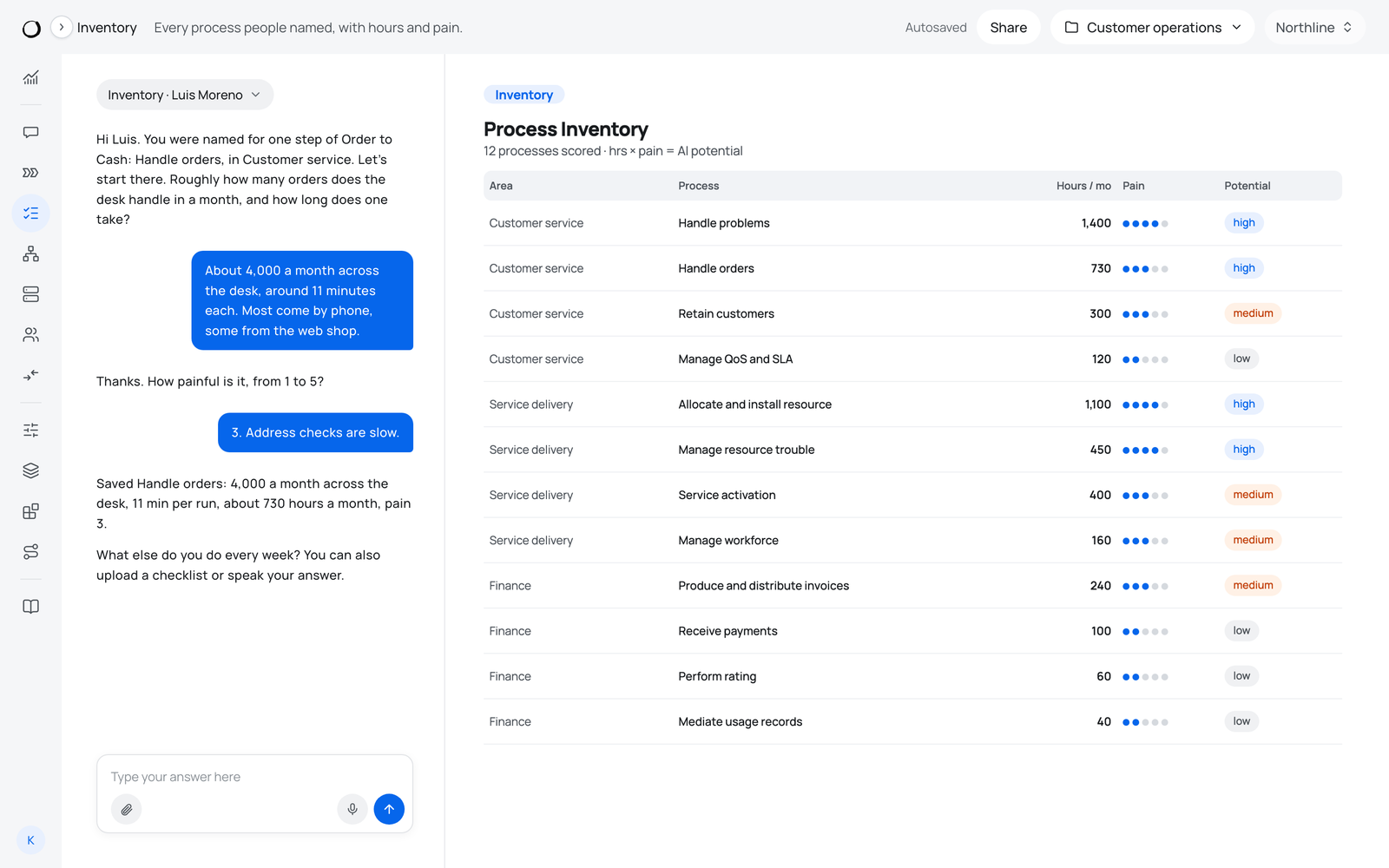
Result: each answer becomes a row in the Inventory and a card in its area on the Value Chain. The Inventory ranks everything by hours a month and pain, and that ranking decides what gets mapped in detail.
In the example, Handle problems comes out on top: 6,000 fault reports a month at 14 minutes each is about 1,400 hours a month.
Why this step: it shows the whole scope in hours and pain before anyone maps in detail. Effort then goes where the time actually goes, not to whoever speaks loudest.
Good to know
- Workarounds and exceptions are the most useful part.
- Customer records and personal data never go in.
- A colleague may describe the same process differently. Both versions are kept, and the Reviewer decides.
- Give the team's volume as the team's: "9,000 contacts a month across a team of 12" is clear, "40 a day" is not.
Done when kawaru.app has read the list back and the person has confirmed it.